Case study · 1.0

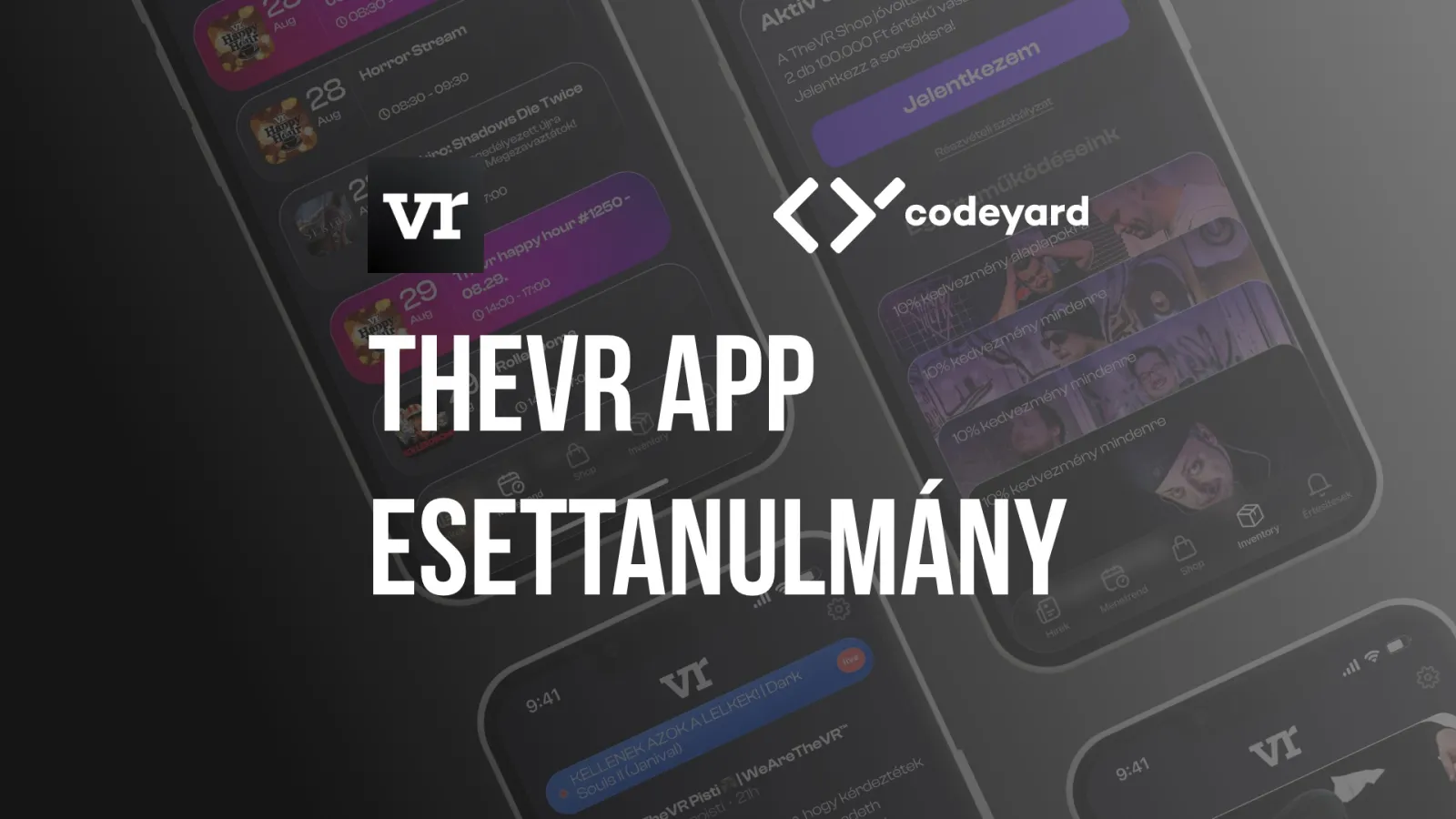
TheVR 1.0: we built it live, with the community.
An app for 3 million followers that TheVR's viewers watched come to life, live on Twitch. On launch morning ~10,000 people opened it at the same time, and that same day it became the #1 free app in both stores.
- Platform
- Native iOS and Android
- Development
- Live, on Twitch
- UI/UX
- Soma Szoboszlai
- Infrastructure
- With the SysCops team
- 3M+followers across TheVR's channels
- ~10,000concurrent users on launch morning, without a hitch
- #1free app on the App Store and Google Play on launch day
- 5★rating from thousands of reviews in both stores
The idea
We've known each other for ten years. It started on a live stream.
We met Jani and Pisti back at startup events in Debrecen. Even then they were demoing VR headsets at a meetup before anyone owned one, while we were building apps and giving talks about the challenges of development.
During a live stream, Jani mentioned they were thinking about an app of their own. We said we'd be happy to help, and at the first meeting we asked them to tell us what they needed, and why.
The goal
A reliable, simple tool for existing fans.
- They didn't expect new viewers or revenue from the app, but a better way to serve their existing community
- Everything fans need day to day, in one place
- Most things update automatically, so the team doesn't have yet another platform to manage
Planning
It could have had countless features. We looked for the lovable ones.
Plenty of things could be useful to a team with a following this size, but they needed a simple system that automates most things. So we deliberately narrowed the scope.
We understood the why
At the first meeting we didn't start with a feature list, but with what the project was for and why they needed it.
Specification and scope
We wrote a requirements specification: we came up with new features and dropped earlier ideas, so the app would stay simple and lovable.
Clickable prototype
Alongside the specification we built a prototype, so the guys could see what they would get before development began.
Options, not questions
We knew they were always busy with their work, so we came with proposals ready for a decision, not questions that add uncertainty.
“In a process like this, a proactive approach counts for a lot. We try to push it to the max on every project, and it's what our clients like most about us.”
The final feature set
Five tabs, all about TheVR.
Soma Szoboszlai turned the prototype into a UI/UX that our developers could work with easily, and that fitted the TheVR brand 100%.
Design: Soma Szoboszlai
An interface built on the prototype and tailored to TheVR's brand identity.
News
The team's posts from various social media platforms in one place.
Schedule
Upcoming streams in calendar form, so no show gets missed.
Shop
The products available in the online shop, grouped into collections.
Inventory
Coupon codes from partnerships, and the home of the prize draws too.
Notifications
Not just about new content: the team can message its followers directly, something no other platform gives them.
Live development
We fell in love with the project, so we built it in public.
We were impressed by the spirit behind it all, so we offered to build it as a community project, live on Twitch, with TheVR's viewers involved. The viewers were very active: we got loads of ideas and feedback during development itself.
Appetite comes
with eating: the app took
shape along the way.
The biggest challenge
Uneven, spiky load.
Websites mentioned during Happy Hour regularly went down under thousands of simultaneous visitors. We didn't want that to happen to us, so we sized the system to stay smooth even if every TheVR follower heard about the app at almost the same moment. The SysCops team, with whom we had already worked on several projects, helped with scaling.
- a few hundredconcurrent users in an average hour
- thousandsopen the app at once after a notification about a new video or post
- 100,000sof near-simultaneous visitors is what we prepared for at launch
AWS, with microservices
The servers run in Amazon's cloud on Kubernetes and Docker, scaling dynamically with the load.
Deliberate caching
We knew at the design stage which data had to be cached. A Redis server helps with that.
MongoDB
A robust, highly scalable database: the obvious choice for this kind of load.
Real-time notifications
With this many users, even sending push notifications isn't trivial. It wasn't our first project like this, so we went in with experience.
Native iOS and Android
Ten years of native mobile development experience, following every change in the platforms.
Cost-efficient scaling
The infrastructure only grows when it needs to, so the budget goes on real usage, not idle capacity.
The launch
It launched live on air, and handled the rush.
We scheduled the launch for a morning Happy Hour: the Android and iOS apps went live during the stream. Thanks to careful planning and experience, the system served ~10,000 concurrent users without any trouble.
We received loads of feedback, thanks and congratulations. In the stores, users gave it 5★ across thousands of reviews. The credit naturally goes to the community, but it felt good to be part of it.
Launch day
#1
among free apps in Hungary, on both the App Store and Google Play.
Ahead of, among others, SkyShowtime, which launched that day with a major campaign:
- BudapestGO
- MySpar
- Vinted
- SkyShowtime
What came next
The lessons of 1.0 gave rise to 2.0: a new home screen, a shop and redesigned notifications.
Contact
Got a business problem you'd solve with software?
Let's talk. We'll help you see the options and find the solution that fits you best.
- Free consultation
- Quick response
- Straight, expert answers
Or write to us directly: business@codeyard.eu